Saturday, January 27, 2007
View Pictures
Below in the links section you will find the flickr site we will store our pictures at. Right now there are some pictures of the front and rear axles, as well as drive shafts.

Friday, January 26, 2007
Drive Train: Cranking
In the last post we got a general idea of what the drive train is and what it is made up of. This post will discuss some of the challenges we face that will help determine the final design of the drive train.
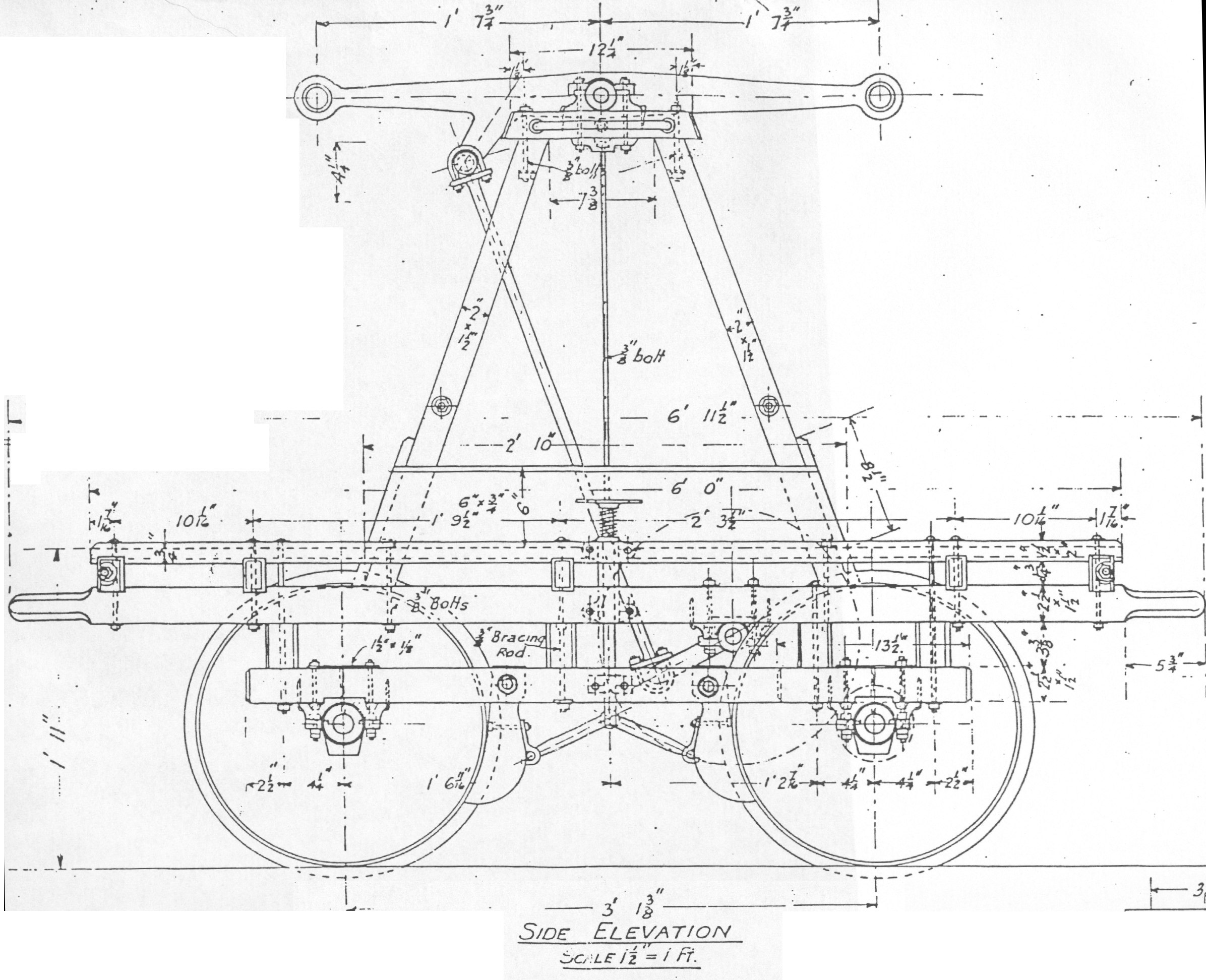
Again, the drive train will turn human up-and-down motion (from people pushing up and down on the pump lever) into rotational motion that will travel to the wheels. A system this can be compared to is a person riding a bicycle. In the case of the hand car the leg will be the pump lever and connecting rod. The bicycle pedal and crank arm will be the crank of the hand car. Using this model we have transformed up-and-down human motion into rotational motion. But a bicycle crank powers a sprocket, which drives a chain. In our case we will connect a drive shaft onto the crank parallel with the rotational axis of the crank. Picture the bicycle again and replace the left-side pedal with a shaft perpendicular to the bicycle. Actually just take a look at this diagram of a hand car. Notice the crank connecting to the crown wheel, this is what we will do, except the crown wheel will be facing the front of the vehicle. The axis of rotation will be in line with the direction of motion of the hand car.
Another issue arises in bracing all these components. We have some ideas for that so stay tuned.
Again, the drive train will turn human up-and-down motion (from people pushing up and down on the pump lever) into rotational motion that will travel to the wheels. A system this can be compared to is a person riding a bicycle. In the case of the hand car the leg will be the pump lever and connecting rod. The bicycle pedal and crank arm will be the crank of the hand car. Using this model we have transformed up-and-down human motion into rotational motion. But a bicycle crank powers a sprocket, which drives a chain. In our case we will connect a drive shaft onto the crank parallel with the rotational axis of the crank. Picture the bicycle again and replace the left-side pedal with a shaft perpendicular to the bicycle. Actually just take a look at this diagram of a hand car. Notice the crank connecting to the crown wheel, this is what we will do, except the crown wheel will be facing the front of the vehicle. The axis of rotation will be in line with the direction of motion of the hand car.
Another issue arises in bracing all these components. We have some ideas for that so stay tuned.
Wednesday, January 24, 2007
Plan of Attack: The Drive Train
After viewing the plans, which were linked in the last post, we can get a general idea of what we need to do. The most important part of this vehicle is the drive train. This is the system that will convert the human energy into mechanical. Once we have established a concept and design, we can begin gathering the pieces and parts to build it. Everything else will be built on top of the drive train. Let's define some parts.
1. The Pump Lever - This is the thing that looks like a see-saw in which the humans push up and down. It is one of the main components converting human power into mechanical power which will make the wheels go 'round and 'round.
2. The Connecting Rod - The connecting rod is connected to the pump lever and is used to turn the drive shaft. The arm is the major component that will change the up-and-down motion from the humans into rotational motion.
3. The Crank - The Crank connects the connecting rod to the drive shaft.
4. The Drive Shaft - The drive shaft carries the rotation motion to the rear axle.
5. Rear Axle - The rear axle is is connected to the drive shaft and distributes the rotational motion to the wheels.
These four components are key to powering the hand car. These are the basic parts. More will be introduce in the future that will aid in the vehicle's motion.
In the spirit of the Green Man, the car should incorporate as much recycled and reused material as possible. This will also save on cash. Another reason for this is because of the nature and size of the vehicle, certain parts must be extremely heavy duty. We don't have the resources or expertise to design and fabricate parts specially for the vehicle. This means more effort must be put in to find the right parts. We may also have to change our design because we don't have the exact part we want but we find something else similar.
Below is a rough sketch of the drive train:

1. The Pump Lever - This is the thing that looks like a see-saw in which the humans push up and down. It is one of the main components converting human power into mechanical power which will make the wheels go 'round and 'round.
2. The Connecting Rod - The connecting rod is connected to the pump lever and is used to turn the drive shaft. The arm is the major component that will change the up-and-down motion from the humans into rotational motion.
3. The Crank - The Crank connects the connecting rod to the drive shaft.
4. The Drive Shaft - The drive shaft carries the rotation motion to the rear axle.
5. Rear Axle - The rear axle is is connected to the drive shaft and distributes the rotational motion to the wheels.
These four components are key to powering the hand car. These are the basic parts. More will be introduce in the future that will aid in the vehicle's motion.
In the spirit of the Green Man, the car should incorporate as much recycled and reused material as possible. This will also save on cash. Another reason for this is because of the nature and size of the vehicle, certain parts must be extremely heavy duty. We don't have the resources or expertise to design and fabricate parts specially for the vehicle. This means more effort must be put in to find the right parts. We may also have to change our design because we don't have the exact part we want but we find something else similar.
Below is a rough sketch of the drive train:

The Vision
The vehicle will be very similar to the hand car seen in the links and pictures on the main page. We will expand to incorporate some new ideas. Of some of these ideas and modifications, many may be unrealistic and will not work with our scope of time and limited budget. Now is not the time to set limits.
The first big modification is for it be "road-worthy." Basically make it so we don't need tracks. A steering mechanism would be nice. Also a brake. The vehicle will need to carry at least 15 - 20 people. It will have to be a lot larger than the typical hand car. Below is an artist's rendition of the vehicle. There are posts in which lanterns are dangling from.

Some other ideas for carrying the large number of people are adding a trailer or a second story.
The first big modification is for it be "road-worthy." Basically make it so we don't need tracks. A steering mechanism would be nice. Also a brake. The vehicle will need to carry at least 15 - 20 people. It will have to be a lot larger than the typical hand car. Below is an artist's rendition of the vehicle. There are posts in which lanterns are dangling from.

Some other ideas for carrying the large number of people are adding a trailer or a second story.
Beginning: Vision + Plan = Reality
This is the first post of the blog. I guess you have a idea of what this blog will be if you have studied the main page and link(s).
The ultimate goal will be achieved when this vision is turned into a reality. It is really hard sometimes but if the process can be broken down into steps and each step is treated as a small goal to be achieved, success is within reach, motivation is at hand, and the feeling of being overwhelmed will be deposited neatly in the shit-house.
The problem we face is a problem many face. When one has never heard or seen of such a thing, how do you build it? A technique we will use can be compared to a rap song, or a better example would be the Grey Album, by Danger Mouse (I think). The Grey album was basically all Jay-Z lyrics from the Black Album, mixed to music from the Beatles' White Album. So basically, use other peoples inventions and techniques and incorporate them into yours.
In regards to this hand car, we will obviously take the design of an original hand car and modify it for the road. Take a look at this link for Plans. This can be found in the link on the main page of this blog. Here you will find actual plans from an old time hand car. Download these jpgs and you will understand the workings of a hand car and how it works.
This is a good place to stop.
The ultimate goal will be achieved when this vision is turned into a reality. It is really hard sometimes but if the process can be broken down into steps and each step is treated as a small goal to be achieved, success is within reach, motivation is at hand, and the feeling of being overwhelmed will be deposited neatly in the shit-house.
The problem we face is a problem many face. When one has never heard or seen of such a thing, how do you build it? A technique we will use can be compared to a rap song, or a better example would be the Grey Album, by Danger Mouse (I think). The Grey album was basically all Jay-Z lyrics from the Black Album, mixed to music from the Beatles' White Album. So basically, use other peoples inventions and techniques and incorporate them into yours.
In regards to this hand car, we will obviously take the design of an original hand car and modify it for the road. Take a look at this link for Plans. This can be found in the link on the main page of this blog. Here you will find actual plans from an old time hand car. Download these jpgs and you will understand the workings of a hand car and how it works.
This is a good place to stop.
Subscribe to:
Comments (Atom)